by Coach Carlo | Jul 30, 2026 | Confidence & Mindset, Mental Performance Tips
Quick Summary: The belief that great athletes are simply born that way is one of the most damaging myths in youth sports. Decades of research point the other way: ability is mostly built through practice, coaching, and the mindset a child brings to setbacks. Treating talent as fixed makes kids quit when it gets hard. Treating it as buildable keeps them growing — and that includes the mental game.
When a kid believes talent is fixed, the first real failure feels like a verdict. When they believe it’s built, failure is just information.
Is athletic talent born or built?
Mostly built. Genetics set some outer limits — height, certain physical traits — but the gap between a good young athlete and a great one is filled almost entirely by practice quality, coaching, and persistence. The kids who look naturally gifted at 10 are usually the ones who started earlier or practiced more, not the ones with rare genes.
How does the “natural talent” myth hurt kids?
It quietly tells a child that effort does not matter. If you are either born with it or not, then struggling must mean you are not one of the gifted ones — so why keep trying? That belief is exactly what shows up right before a kid quits. It also makes praise backfire: a child praised for being talented avoids harder challenges to protect the label.
“A child praised for being talented learns to avoid anything that might prove they’re not.”
What should parents say instead?
Shift praise from the trait to the process. The words are small but the effect compounds over a season.
Praise the Build, Not the Gift
Small words, season-long effect
Instead of
“You’re a natural.”
“You’re so talented.”
“You always win.”
Try
“You worked hard for that.”
“I saw you stick with it.”
“You figured it out.”
Does this apply to the mental game too?
Especially the mental game. Confidence, composure, and focus are the most “fixed-looking” traits of all — and the most trainable. A child who melts down after a mistake is not missing a talent gene; they are missing a skill nobody taught them yet. That is the entire premise behind the RISE Method: the mental side is coachable, one step at a time.
Frequently asked questions
Doesn’t natural talent exist at all?
Raw physical traits exist, but they are a small part of the picture and useless without development. The deciding factor at the youth level is almost always practice and persistence, not genetics.
My child says they’re “just not good at” a sport. What do I do?
Reframe it as “not yet.” Point to a specific skill they improved through effort to make the buildable nature of ability concrete and personal.
Is it too late if my kid started late?
No. Late starters routinely catch and pass early “naturals” because development, not birthdate, drives long-term skill.
Talent is built. So is the belief that keeps a kid building.
Audacity Sports — Mental Performance Academy for Youth Athletes

by Coach Carlo | Jul 27, 2026 | Sports Parenting
Quick Summary: Most sports parents would never intend to pressure their child — yet tone, body language, and the car-ride questions can send a louder message than we realize. Kids read our nervous system before they hear our words. The good news: a few small shifts on the sideline and after games can turn you from a source of pressure into your child’s steadiest advantage.
Your child is watching the sideline as closely as the scoreboard. You are the mirror they check.
Can a parent accidentally add pressure?
Easily — and usually without a word. Kids are expert readers of the adults who love them. A tight jaw after an error, a groan from the stands, or a rushed “what happened out there?” all register as data: this matters to Mom or Dad, and I might be disappointing them. That low hum of evaluation is exactly what turns a game a child once loved into a test they are afraid to fail.
What are the signs I might be adding pressure?
None of these make you a bad parent — they are common, and fixable once you see them.
The Sideline Check
Three quiet pressure signals
Coaching from the stands
Instructions mid-play split their focus and signal your worry.
Result-first questions
“Did you win?” before “Did you have fun?” tells them the score is what counts.
Visible reactions to errors
A wince or head-shake gets seen — and remembered — mid-game.
“Kids read your nervous system before they hear your words.”
How do I become a calming presence instead?
Pick one job on the sideline: be the calm. Cheer effort, not just outcomes. Save all instruction for the coach. And lead your post-game conversation with connection — “I love watching you play” — before anything about performance. When your child glances over after a mistake, let the mirror they see reflect steadiness, not stress.
Frequently asked questions
Is it wrong to want my child to succeed?
Not at all. The aim is not to care less — it is to keep your care from reading as pressure. Channel it into support for their effort rather than reactions to their results.
My child says I stress them out at games. What now?
Take it as useful feedback, not an attack. Ask what specifically would help — often it is simply “stop yelling tips” or “don’t look upset.” Then honor it.
Should I stop coming to games?
Rarely the answer. Your presence matters; it is the type of presence that counts. A calm, supportive parent in the stands is a gift.
Be the calm they check for. That’s the whole job.
Audacity Sports — Mental Performance Academy for Youth Athletes
by Coach Carlo | Jul 14, 2026 | Mental Performance Tips, Sports Parenting
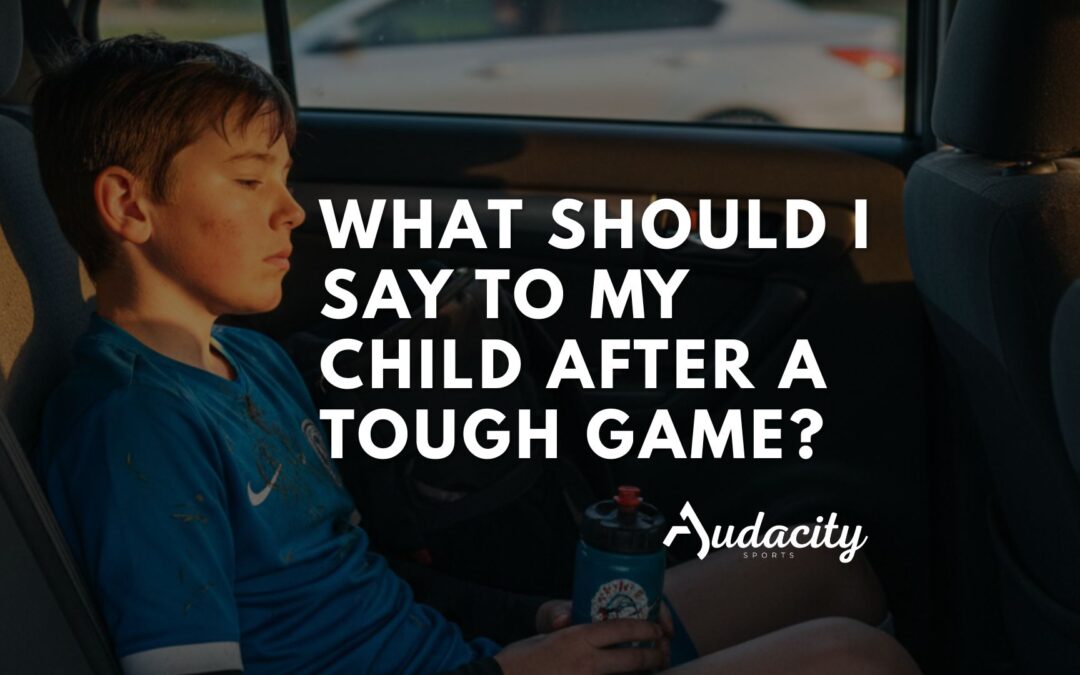
Quick Summary: The car ride home after a tough game is one of the most important — and most mishandled — moments in youth sports. Kids are raw, and what a parent says in the first few minutes can either rebuild them or deepen the sting. The short version: lead with connection, not analysis. Ask before you tell. And save the coaching for later, if at all.
Your kid isn’t looking for a post-game analyst on the ride home. They’re looking for a parent.
What should I say to my child after a tough game?
Start with five simple words: “I love watching you play.” Sports psychologists have pointed to this phrase for years because it does something powerful — it separates your love and approval from the result. After a loss, a kid is already wondering if they let you down. Leading with connection answers that fear before it grows.
Then go quiet. Let them set the tone. Some kids want to talk; many just want to feel normal again. Both are fine.
What should I avoid saying?
Avoid the instant breakdown of what went wrong, even when you mean well. In the raw minutes after a loss, “you should have…” lands as “you failed.” Also skip blaming refs, coaches, or teammates — it teaches kids to look outside themselves instead of focusing on what they control.
“In the raw minutes after a loss, ‘you should have’ lands as ‘you failed.’”
What is the best first question to ask?
Ask about experience before performance. A simple, low-pressure opener invites them in without putting them on trial.
The Ride-Home Reset
Three moves, in order
1. Connect
“I love watching you play.” Approval first, before anything about the game.
2. Ask
“What was that like for you?” Let them lead. Listen more than you talk.
3. Wait
Save any teaching for the next day, once the emotion has cooled — if it’s needed at all.
Why does the car ride home matter so much?
Because it repeats. Multiply one ride home by a whole season and you are training your child’s relationship with failure itself. Handled well, tough games become reps in resilience. Handled poorly, they become reasons to dread playing — and eventually, reasons to quit.
Frequently asked questions
What if my child wants to vent or cry?
Let them. Validate the feeling without rushing to fix it: “That one hurt — I get it.” Emotions move through faster when they are allowed, not argued with.
When is it okay to give feedback?
Later, and only if they are open to it. The next day, you can ask, “Want to talk about that play?” If they say no, respect it. Their coach handles coaching; you handle support.
My child shuts down completely. Is that bad?
No. Silence is a normal way to process. Stay present, keep it light, and let them know you are there when they are ready.
Win the ride home, and you win the season.
Audacity Sports — Mental Performance Academy for Youth Athletes

by Coach Carlo | Jun 26, 2026 | Pressure & Composure, Youth Sports News
Quick Summary: Roughly 70% of kids quit organized sports by age 13, and it is rarely about talent or losing their love for the game. Most walk away because the mental side of sport — the pressure, the nerves, the fear of failing in front of people — is the one part nobody ever trained them to handle. The encouraging news: those mental skills are learnable, not fixed. A simple framework called the RISE Method (Regulate, Identify, Speak, Execute) gives parents a way to coach them at home.
70%
of kids quit organized sports by age 13
Why do so many kids quit sports by age 13?
It is one of the most consistent findings in youth athletics: about 7 in 10 kids step away from organized sports before they finish middle school. Parents often assume their child simply lost interest or was not good enough. The reality is usually different.
When you ask kids directly, the reasons cluster around a few themes:
- It stopped being fun. What started as play became a source of stress.
- Too much pressure. The fear of letting down a coach, a parent, or teammates outweighed the joy of competing.
- Fear of making mistakes. One bad game or one missed shot started to feel like a verdict on who they are.
- No way to handle the nerves. The physical skills were there, but the moment got too big and nobody taught them how to settle themselves down.
Notice what is missing from that list: talent. Most kids do not quit because they cannot play. They quit because the experience became emotionally heavier than it was worth.
“Most kids don’t quit because they can’t play. They quit because the experience became heavier than it was worth.”
The part of every young athlete nobody trains
Think about how a typical young athlete spends their week. Drills, conditioning, footwork, reps. Every bit of it trains the body. Almost none of it trains the mind.
Yet ask any athlete what decided their biggest games and they will tell you it was confidence, composure, or focus — not their forty time. The mental game is the untrained half of every young athlete, and it quietly determines whether they rise or quit.
“The mental game is the untrained half of every young athlete.”
Is the mental game something kids are just born with?
No. This is the myth that does the most damage. We treat composure and confidence as fixed traits — your kid either has it or they do not. They are skills. A child who falls apart after a mistake today can learn to reset and refocus, the same way they learned to dribble or field a grounder. It takes coaching and practice, not better genes.
How can parents help? The RISE Method
You do not need a sports psychology degree to start. The RISE Method breaks the mental game into four steps you can reinforce on the car ride home or before a game.
The RISE Method
Four steps to train the mental game
R
Regulate
Calm the nervous system with slow breathing and a pre-game routine.
I
Identify
Name the feeling and the thought behind it. You cannot manage what you cannot name.
S
Speak
Reframe the inner voice into a kinder, more useful script.
E
Execute
Shift focus to the next controllable action, not the outcome.
R — Regulate
Before anything else, help your child manage their nervous system. Slow breathing, a physical reset, a routine before they step on the field. A regulated body is the foundation for a clear mind.
I — Identify
Teach them to name what they are feeling and the thought behind it. “I am nervous because I am scared to mess up” is a workable starting point. You cannot manage what you cannot name.
S — Speak
Reframe the inner voice. The story a kid tells themselves after a mistake — “I am terrible at this” versus “that is one play, next one” — shapes what happens next. Help them build a kinder, more useful script.
E — Execute
Shift attention from the outcome to the next controllable action. Not “we have to win” but “win the next play.” Execution lives in the present, where nerves lose their grip.
Frequently asked questions
At what age should kids start mental performance training?
As soon as they start competing in a way that creates pressure — often as early as 7 or 8. The skills are introduced in age-appropriate ways: simple breathing and self-talk for younger kids, more detailed routines as they mature.
Is not pushing through nerves just part of sports?
Some discomfort is normal and even healthy. The problem is expecting kids to push through without ever teaching them how. That is what leads to burnout and quitting, not the nerves themselves.
What should I do if my child says they want to quit?
Get curious before you react. Ask what specifically is not fun anymore. Often the answer points to pressure or fear of failure — exactly the things mental performance skills are built to address — rather than a true loss of interest in the sport.
Train the mental game. Keep them in the game they love.
Audacity Sports — Mental Performance Academy for Youth Athletes